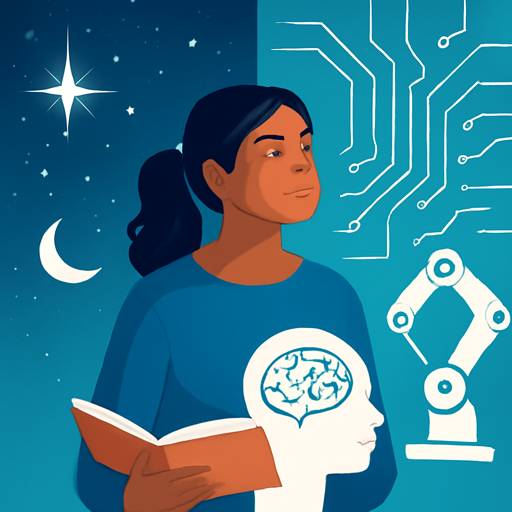
From Stars to Circuits: Student-Ready Frontiers in Astronomy, Cognition, and Robotics
Ambitious learners want projects that spark curiosity and build real skills. Whether peering into distant galaxies, decoding how the brain pays attention, or teaching small robots to collaborate, hands-on research shapes confident problem-solvers. The following sections distill high-impact pathways in astronomy, cognitive science, and robotics that fit timelines, budgets, and classroom or club environments. Each path balances theory with practical steps, open datasets or low-cost tools, and clear outcomes a portfolio or science fair judge can recognize. Along the way, core keywords like astronomy research ideas, Space Telescope Projects, cognitive science for high school, humanoid robotics for students, and collaborative robot swarms guide the journey.
Astronomy Research Ideas and Space Telescope Projects You Can Start This Semester
Modern astronomy is data-rich and student-friendly. Telescope archives open the door to authentic discovery, turning curiosity into measurable results. Start by shaping a focused question—“Which open clusters in Gaia DR3 show evidence of mass segregation?” or “How consistent are TESS-derived exoplanet transit depths across observational sectors?”—and then match it to a dataset. Public missions deliver an abundance of material: TESS light curves for transit detection, Hubble and JWST imaging for morphology and photometry, Pan-STARRS for near-Earth objects, and Gaia for stellar distances and motions. These are natural springboards for astronomy research ideas that do not require a personal telescope.
In “mini” Space Telescope Projects, build a pipeline around accessible software. For time-series analysis, Lightkurve and AstroPy streamline data loading, detrending, and period searches. For imaging, SAOImage DS9 for visualization and photometry, or Python-based photutils for aperture measurements, work well. A classic pathway is exoplanet validation: identify candidate dips in TESS light curves, rule out systematics using comparison stars, and check candidate status against the ExoFOP-TESS database. A second option involves variable-star classification: extract periods from ASAS-SN or ZTF data, generate phase-folded light curves, and compare features to known types (RR Lyrae, Cepheids, eclipsing binaries). Students can also perform asteroid light-curve analysis to estimate rotation periods using ZTF observations.
For Earth-based observing, a DSLR with a tripod and a 50mm lens captures wide-field sequences for meteor counts or satellite flare statistics. With a small tracking mount, conduct differential photometry on bright variables. Remote observatories (e.g., through educational networks) unlock narrower-band imaging; study H-alpha emissions in nebulae or create color-magnitude diagrams for nearby clusters. Case study: a two-week exoplanet transit replication. Target a hot Jupiter with a known ephemeris, capture several hours of images around predicted mid-transit, perform aperture photometry on the target and reference stars, and fit a model to estimate transit depth. Outcome: a figure-backed result comparing your depth to TESS values, plus a discussion of noise sources and improvements, which is ideal for a research poster or competition.
Cognitive Science for High School: Experiments that Reveal How Minds Learn
Behavioral science thrives on well-defined, replicable experiments. With careful planning and ethics-minded data collection, cognitive science for high school can produce compelling results in weeks. Start by pinpointing a cognitive process—attention, memory, perception, or decision-making—and framing a hypothesis with a measurable outcome. For instance: “Interleaved practice will yield higher retention scores than blocked practice in algebraic factoring after 72 hours,” or “Dual-task interference increases reaction times compared with single-task conditions.”
Design an experiment with clear stimuli, instructions, and timing. The Stroop effect offers a classic blueprint: color-word conflicts extend response time and elevate error rates. Implement with PsychoPy, PsychoJS, jsPsych, or even a timed Google Form for basic versions. For memory, run a spaced-retrieval study: assign two groups different study schedules (massed vs. spaced), ensure equal total time, then administer a delayed test. To quantify effects, collect sample sizes of at least 20–30 participants per group when possible, report mean differences with 95% CIs, and compute effect sizes (Cohen’s d). Data ethics come first: obtain consent, anonymize responses, and limit sensitive information.
Real-world classroom case study: an investigation of retrieval practice. Two matched student groups learn the same vocabulary set. One group rereads the list thrice; the other alternates self-testing and feedback twice. A delayed test 48 hours later measures recall. Typical findings show the testing group outperforming the rereading group by a moderate effect size. Such a study not only highlights mechanisms behind durable learning but also leaves participants with tools to improve their own study strategies. Extensions include visual attention studies using a change-detection task, working memory limits with digit spans, and metacognitive calibration by comparing confidence ratings to actual accuracy. Analysis can be run in spreadsheets or Python (pandas and scipy). The key: operationalize a cognitive theory, gather clean data, and present results with transparent methods and limitations.
Humanoid and Swarm Robotics: Project Pathways from Single Bot to Team Intelligence
Robotics blends mechanics, control, and computation into concrete achievements. For humanoid robotics for students, start with locomotion and balance. A 2–3 DOF leg module using micro servos demonstrates gait cycles and the inverted pendulum concept. Add an IMU to stabilize motion with complementary or Kalman filtering, and use a microcontroller (Arduino, ESP32, or Raspberry Pi Pico) to run control loops at steady intervals. Simulators like Webots, Gazebo, or PyBullet allow safe iteration on gait parameters and foot trajectory planning before building hardware. Progression milestones include stable single-step balancing, straight-line walking over short distances, and turning-in-place routines. Introduce computer vision via a light-weight model or OpenCV pipeline for line following or color-based object tracking; then integrate the perception signals into foot placement heuristics.
Swarm systems highlight distributed problem-solving. Begin with 3–5 simple wheeled robots equipped with proximity sensors and low-bandwidth communication (BLE, ESP-NOW, or Zigbee). Implement flocking behaviors using Reynolds’ Boids—separation, alignment, and cohesion—and show emergent patterns in confined spaces. Next, add formation control: assign virtual goals (a triangle or wedge), allow local negotiation, and maintain formations while avoiding obstacles. For collaborative exploration, deploy occupancy-grid mapping in a small arena. Each robot updates a local map; robots exchange partial maps periodically to build a global picture. Task allocation can follow market-based auctions: robots bid for jobs (scan zone A, deliver block B), minimizing total cost. These steps mirror industry uses in warehouse logistics and environmental monitoring.
For inspiration and starter kits, browse Swarm robotics student projects that illustrate hardware lists, communication choices, and testing arenas. A compact capstone combines both domains: a minimal biped that signals its status to a swarm of scouts. The humanoid requests parts; swarm units fetch and deliver while avoiding collisions and updating a shared map. Evaluation metrics include delivery time, collision rate, and battery usage per mission. As confidence grows, explore ROS 2 for multi-robot coordination, SLAM packages for mapping, and reinforcement learning for role assignment. Keep builds modular: standardized chassis plates, swappable sensor pods, and unified power distributions reduce downtime. Safety matters—current-limited drivers, protective gearing, and failsafes—so prototypes survive the inevitable crashes as algorithms improve.